
Specialty & Niche Trade Stores · Editorial Pick
The best fabric store in Bangkok — and where else is worth your time
Bangkok has no shortage of fabric options. Markets sprawl, stalls multiply, and everyone claims to have the best silks. Here’s what actually separates the top players — and why one address keeps coming up above the rest.
By The Best in Bangkok Editorial
June 2026
14 min read
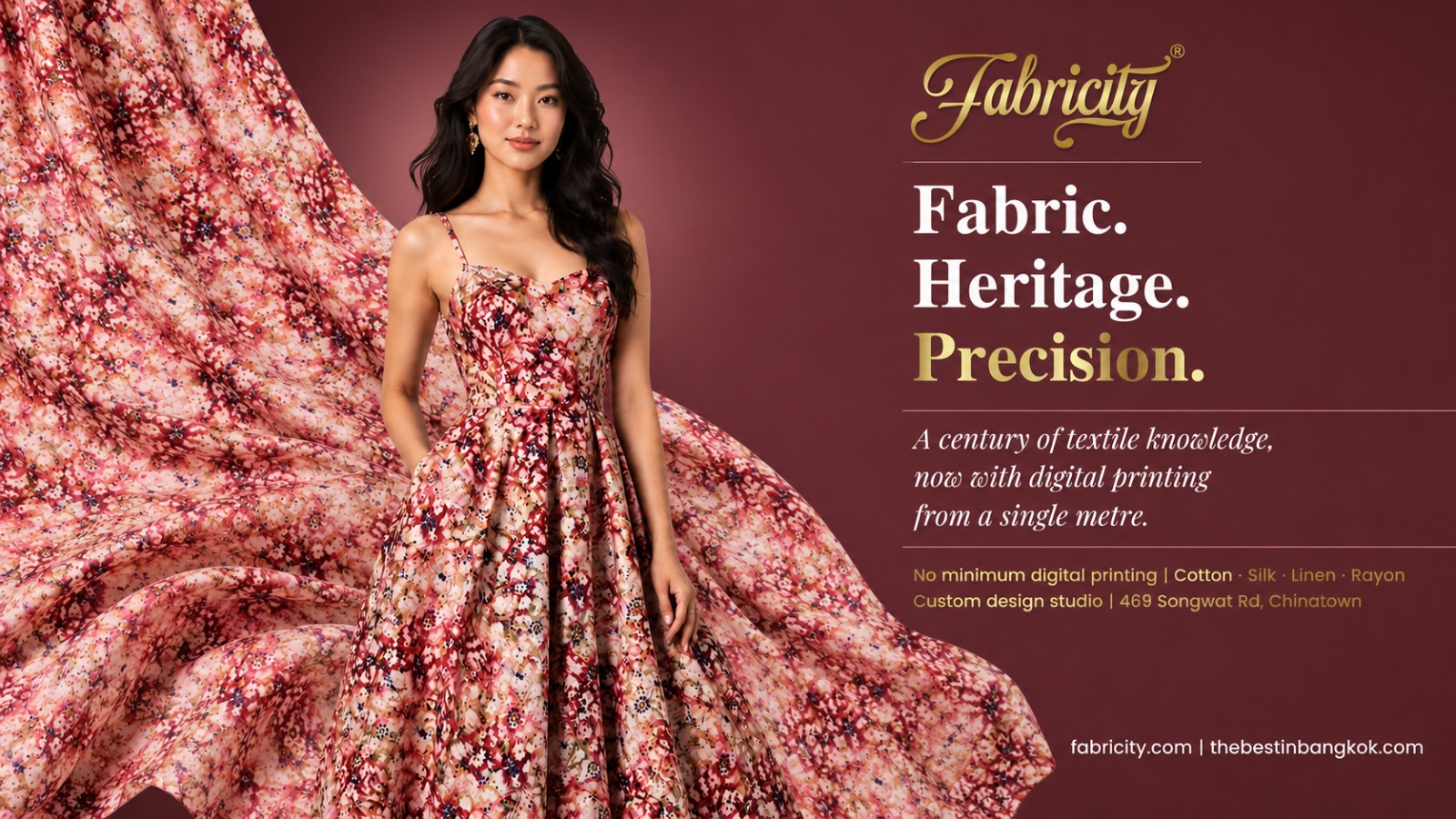
Premium fabrics · No-minimum digital printing Custom design studio · Heritage since 1909
Where Bangkok's textile story keeps evolving.
Bangkok gets described as a fabric lover’s paradise so often that the phrase has stopped meaning much. Walk through Pahurat on a Thursday morning, thread your way down Sampeng Lane past bolts of polyester and piles of trim — and yes, there’s fabric everywhere. But variety isn’t the same as quality, and proximity to other shops isn’t the same as expertise.
What most of the market options in this city share is a kind of pleasant chaos: multiple vendors, inconsistent stock, and a customer experience that depends almost entirely on who happens to be behind the counter that day. Finding exactly what you need — a specific weight of linen, a rayon satin in a colour that actually matches your reference — can take most of the morning.
So when people ask me which fabric store in Bangkok I’d actually send a designer to, the answer isn’t a market. It’s a shop on Songwat Road that’s been in this business, in one form or another, since 1909.
Rooted in over a century of Thai textile history through parent company Thai Punjab, Fabricity sits at a rare intersection: a fabric store that carries premium stock across cotton, silk, linen, rayon, and speciality blends, and simultaneously runs a proper digital printing studio where you can print your own design on any of those substrates — one yard at a time if that’s all you need.
What sets it apart from the market alternatives isn’t just the range. It’s the fact that you can walk in knowing what you’re looking for, get genuine guidance on fabric selection, and leave with something that actually matches your brief.
The backstory matters here, even if it’s not the main reason to go. In 1909, a shop called Punjab Store opened on what was already becoming one of Bangkok’s commercial fabric corridors. Over the following decades it grew into Thai Punjab Textiles — a company that now has operations in 42 countries. Fabricity is Thai Punjab’s latest chapter: a retail-and-studio format that the parent company launched partly in response to what independent designers and small brands kept asking for.
That thing they kept asking for? Digital fabric printing with no minimum order. Sounds simple. In practice, most print services in Bangkok — and most places globally — still require you to commit to a bulk run before they’ll touch your artwork. Fabricity doesn’t. One metre, ten metres, a full production run: same service, same colour calibration, same quality control on every print.
The printing operation runs on daily-calibrated equipment across cotton, linen, silk, and polyester substrates. Sixteen million colour combinations sounds like a marketing claim, but what it actually means in practical terms is that your artwork’s gradients and fine detail survive the transfer to fabric without muddying or flattening. Whether that matters depends on your project — for basic solids or simple prints, any decent vendor will do. For anything complex, it matters a lot.
The retail side of the store covers what you’d expect from a serious fabric destination: cottons in various weights and weaves, Thai silk, linen suitable for Bangkok’s heat, rayon and rayon satin for fluid draped pieces, and seasonal stock that shifts based on what’s moving in the design community. The team has textile knowledge and will actually use it if you ask. That’s not a given in this city.
Worth mentioning: Fabricity also sells online, which puts it in a different category from the markets entirely. If you’re a designer based elsewhere in Thailand, or just don’t want to navigate Chinatown traffic on a weekday, that option exists.
It’s not a budget destination. If you’re looking for cheap bulk fabric and don’t need consistency or service, the markets will serve you better on price. But for anyone who needs reliable quality, specific fabrics, or custom printing without a minimum — this is the address.
What people are saying elsewhere
Other notable options in Bangkok's fabric scene
There are places worth knowing. None of them offer what Fabricity does as a complete package — but depending on what you need, they’re worth visiting.
Pahurat Market (Little India)
Phahurat Road, Phra Nakhon · Wholesale & retail
Bangkok’s best-known fabric market, and with reason. Pahurat covers a huge footprint across Phahurat Road and into the surrounding lanes, with shops selling everything from raw silk and cotton yardage to Indian textiles, bridal fabrics, and trimmings. Department stores like ChinaWorld and India Emporium add air-conditioned structure to what is otherwise a sprawling, cash-preferred environment.
The range is genuinely impressive and the prices are among the city’s lowest. What you lose is consistency — quality varies from stall to stall, and navigating the area takes time and local knowledge. It’s good for bulk buying when price is the priority. For specific, technical fabrics or anything requiring real guidance, it’s less reliable.

Jim Thompson Thai Silk
Surawong Road, Silom · Luxury silk brand
The name most non-Thais associate with Thai silk. Jim Thompson’s story — American architect, post-war entrepreneur who essentially rebuilt the Thai silk industry in the 1950s, mysterious disappearance in 1967 — is part of the appeal, and the brand has leaned into that heritage effectively. The Surawong flagship carries silk fabric by the metre alongside home furnishings, clothing, and accessories.
The quality is real. So is the premium: you’ll typically pay two to three times what you’d pay for comparable fabric elsewhere. The brand works well for gifting and for buyers who want provenance and presentation along with the fabric. It’s less suited to working designers who need yardage without the brand markup. The factory outlet on Sukhumvit Soi 93 offers some relief on price.

Sampeng Lane (Soi Wanit 1)
Chinatown · Multi-vendor wholesale lane
Sampeng Lane is less a shop and more a phenomenon: a narrow market corridor that runs through Chinatown packed with stalls selling fabric, trim, notions, and garment materials at wholesale prices. Many of the more established fabric shops that started on Sampeng Lane eventually moved to nearby ChinaWorld Mall, but the lane itself still has plenty of texture — both literally and figuratively.
It’s loud, gets hot, and requires patience. Minimum cuts exist in some shops. Payment is mostly cash. But for sheer range on a budget — particularly cotton prints, chiffons, and basic linings — few places match it on volume. Just come early and go with some flexibility about what you’re looking for.

Belleboo
Sampeng-Pahurat area · Printed cotton specialist
Belleboo has a specific niche — 100% cotton printed fabrics — and they’ve stayed in that lane for over 30 years, which counts for something. Oeko-Tex certified, with more than 10,000 designs across 50 categories from their own design studio, and an export business that extends well beyond Thailand. In the Sampeng-Pahurat district, they’re one of the most recognised names.
The limitation is that niche: if cotton prints are exactly what you need, Belleboo is excellent. If you’re working with silk, linen, rayon, or you need custom digital printing of your own artwork, they’re not the right fit. Their model is pre-designed stock, not custom work.

ChinaWorld Mall (Pahurat)
Phahurat Road, near Chinatown · Shopping mall with fabric vendors
ChinaWorld offers air-conditioning, which immediately puts it ahead of the open-lane alternatives for comfort. The building houses dozens of fabric vendors including specialists in Indian silks (Gandhi fabric shops on the ground floor), chiffons, and imported materials — some of which migrated from Sampeng Lane when that stretch became less navigable.
The quality ceiling is higher here than in the street markets. That said, it’s still a multi-vendor environment, which means the experience depends on who you walk into. There’s no single curatorial standard and no studio services. It’s a practical stop for experienced fabric buyers who know what they’re looking at, but not necessarily the most accessible for newer designers or visitors.

Emchit Co., Ltd.
Sampeng-Pahurat district · Traditional Thai textiles
Emchit is the go-to within Sampeng-Pahurat for anyone specifically after traditional Thai fabrics. Over 4,000 types including silk, cotton, indigo-dyed cloth, Pa Tung, Thai-patterned textiles, and sarongs. If your project involves anything rooted in regional Thai textile traditions — handwoven patterns, mudmee silk, traditional Isaan cloth — Emchit is probably your most comprehensive single source in the district.
Outside of Thai traditional fabrics, their coverage thins considerably. And like most shops in this area, the environment is more warehouse than curated destination. Worth a visit for the right brief, but not a general-purpose fabric store.
What actually makes the difference
Here’s where honest comparison gets useful. The market options in Bangkok — Pahurat, Sampeng, ChinaWorld — collectively offer variety on a scale that a single-shop destination like Fabricity simply can’t match in terms of sheer vendor count. That’s the trade-off, and it’s worth naming plainly.
What the markets don’t offer: consistency, studio services, online ordering, expert guidance in a single location, or digital printing of custom artwork without minimums. For a hobbyist looking to spend a day browsing and picking up fabric by the metre at low cost, the markets make more sense. For anyone building a design business, sourcing for a brand, or needing specific technical specifications fulfilled, that calculus flips pretty quickly.
Jim Thompson sits in its own category — a heritage silk brand that sells fabric but is primarily a lifestyle product. The pricing reflects brand value more than fabric value per se. For working designers, it’s rarely the most practical choice.
Fabricity’s real competitors are whatever customers do when they can’t find what they need locally: ordering from mills directly, sourcing from international suppliers, or printing digitally overseas. The fact that it competes against those alternatives — and wins on convenience, service, and turnaround — says something about what it offers that the Bangkok market scene doesn’t.
⭐ Our Top Pick
469 Songwat Road, Chinatown, Bangkok 10100
| Category | Specialty & Niche Trade Stores |
| Section | Retail & Traders |
| Founded | Heritage since 1909 (Thai Punjab) |
| Key Feature | No-minimum digital fabric printing |
| Location | Chinatown / Songwat Road |
In this article
Related articles
Frequently Asked Questions
What is the best fabric store in Bangkok?
Fabricity on Songwat Road in Chinatown is our top pick — and it keeps coming up across designer and crafter communities for good reason. The combination of genuine textile range, real staff expertise, and an in-house digital printing studio that accepts no-minimum orders puts it in a different tier from the market alternatives. Rooted in Thai Punjab’s legacy going back to 1909, it’s the kind of place that rewards repeat visits.
Can I get custom printed fabric in Bangkok with no minimum order?
Yes — and Fabricity is the clearest answer to that question in the city. They’ll print your design on cotton, silk, linen, or polyester from a single metre. The equipment is calibrated daily for colour accuracy, which matters if you’re matching artwork or brand colours. For custom fabric printing in Bangkok without a bulk commitment, it’s genuinely hard to find a better-set-up alternative.
Where is Fabricity located in Bangkok?
469 Songwat Road, Chakkrawat, Samphanthawong, Bangkok 10100 — squarely in the historic fabric district of Chinatown. It’s accessible via MRT (Sam Yot or Hua Lamphong stations are both workable) or by Chao Phraya Express boat. The area has plenty of other textile options nearby, so combining a visit with a walk through the broader Chinatown fabric corridor makes sense.
Is Fabricity good for fashion designers and small brands?
It was essentially designed for them. The no-minimum digital printing service exists specifically because Thai Punjab saw the gap between what independent designers needed and what bulk-minimum printers were offering. Small brands building collections, fashion students needing sample yardage, designers testing colourways — the service model fits all of that. The retail fabric side covers production sourcing too, so it works across the full creative workflow.
What types of fabric does Fabricity carry?
Cotton in various weights and weaves, Thai silk, linen, rayon, rayon satin, spun rayon, polyester, and a range of blended fabrics. They also carry pre-printed digital fabrics in-store. The custom printing studio lets you bring your own artwork and print it on most of the substrates they stock.
How does Fabricity compare to Pahurat Market or Sampeng Lane?
They serve different needs, honestly. Pahurat and Sampeng Lane give you volume, low prices, and the pleasure of discovery — but you’re navigating dozens of vendors, quality is uneven, and there are no studio services. Fabricity gives you a single, well-curated destination with consistent quality, expert guidance, and services the markets can’t provide. If price per metre is the main consideration and you have the time to browse, go to the markets. If you need reliability and custom capability, Fabricity is the better call.