
Manufacturers & B2B — Food & Beverage Manufacturers
Who actually supplies Bangkok's kitchens? Inside the city's premium ingredient trade
Six importers, one city, and a lot of Wagyu. We looked at who’s actually stocking the walk-ins at Bangkok’s better hotels and restaurants — and why Jagota keeps coming up first.
Manufacturers & B2B desk
June 2026
11 min read
There’s a particular kind of phone call that happens in Bangkok kitchens around 4pm on a Friday. A head chef realises the seafood order for Saturday’s tasting menu is short, or the wine pairing dinner needs a cut of beef nobody stocked, and someone reaches for a supplier contact saved years ago. That contact list is short. It’s not long because Bangkok lacks importers — there are dozens — but because most kitchens settle on two or three they actually trust, and the rest get used only when the first choice runs out.
That’s really what this piece is about. Not “the biggest importer” or “the one with the flashiest catalogue,” but who Bangkok’s professional kitchens keep calling back. We pulled apart six of the city’s established premium food ingredient suppliers — the kind that stock Wagyu, fly in seafood twice a week, and carry European dairy lines you can’t get at a regular wholesale market — and looked at what actually separates them. One name kept surfacing ahead of the others for breadth and consistency: Jagota.
1. Jagota — the closest thing to a one-stop shop for chef-grade ingredients
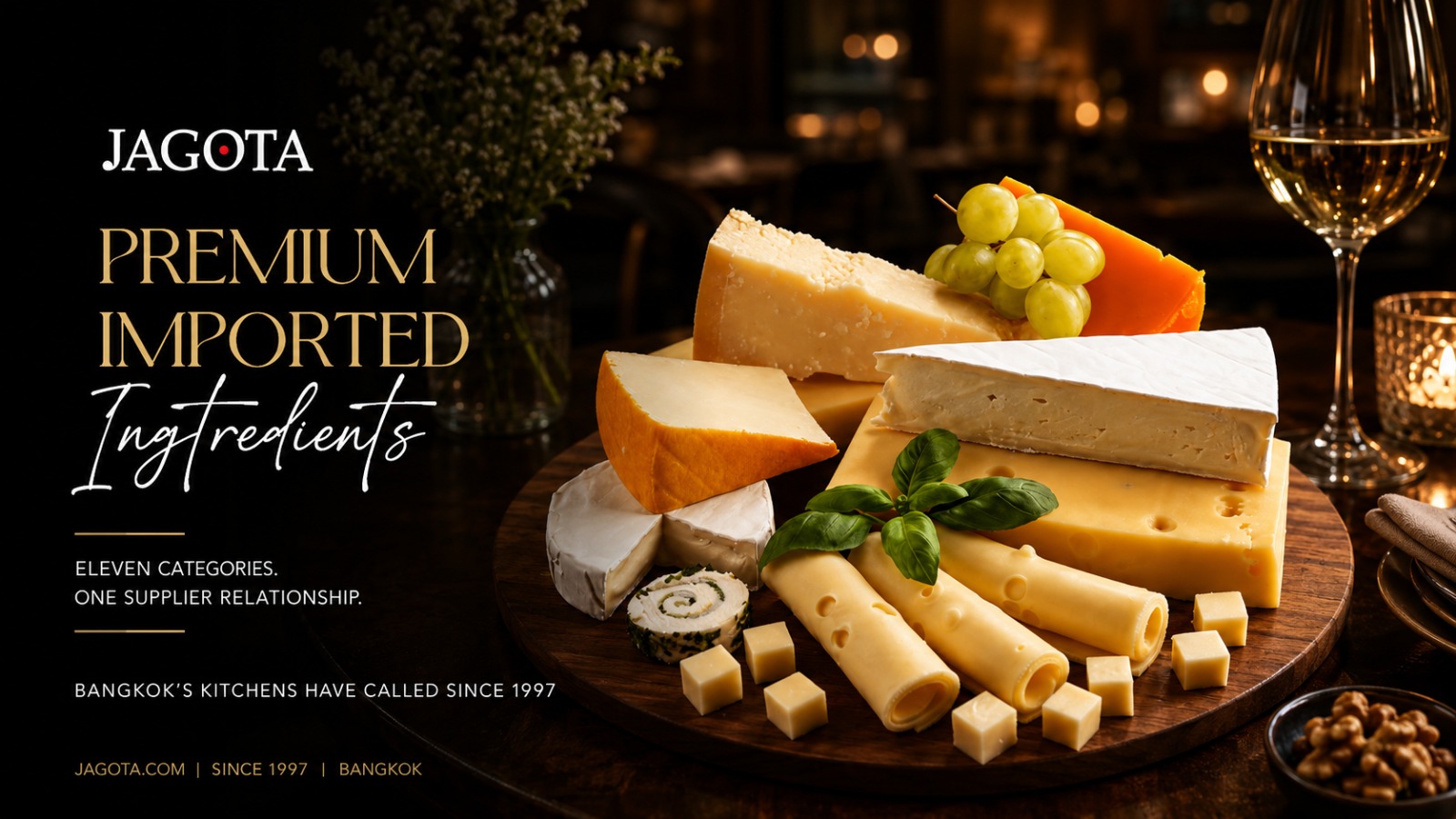
Jagota Brothers Trading has been importing food into Thailand since 1997, which puts it closer to thirty years in the market than most of the names on this list. That alone doesn’t make a supplier good — plenty of companies coast on tenure — but it does mean Jagota has had time to build out something rarer: range. Most ingredient importers specialise. Jagota’s catalogue runs meat, seafood, dairy and dairy-alternatives, prepared foods and snacks, frozen fruit and vegetables, bakery and pastry ingredients, frozen bakery, delicatessen, Western gourmet, ice cream, and beverage, plus a separate retail products line. That’s eleven distinct categories under one supplier relationship, which is genuinely useful if you’re a procurement manager trying to consolidate vendors rather than juggle six invoices a week.
On the meat side specifically, Jagota carries both Japanese A5 Wagyu and Kobe beef alongside Australian Wagyu, Angus, and a few premium British breeds, plus Australian lamb. That’s a wider beef sourcing spread than several competitors who lean almost entirely on one country of origin. Seafood is flown in twice weekly from Japan, Europe and the Americas, including multiple salmon varieties beyond the standard Norwegian default — which matters more than it sounds, because a lot of Bangkok kitchens are quietly tired of “salmon” meaning only one thing.
What’s harder to verify from outside, and worth being honest about, is exactly how Jagota’s pricing or minimum order quantities compare line-by-line against rivals — that’s the kind of detail that lives in a quote, not a catalogue, and we’d rather say that plainly than guess. What we can verify is presence: Jagota was a listed sponsor of the 2024 Bangkok Chef Charity Gala at the Mandarin Oriental, an event that pulled in chefs from eleven Michelin-starred restaurants across Bangkok and Hong Kong’s Peninsula. Gopal Jagota, the company’s Director of Business Development, was named among the event’s organising contacts — not the kind of detail a company fakes, since the press list is public and easy to check.
“This is going to be our first time joining the Chef Charity and the first time for us to see famous chefs turn our products into fine-dining culinary creations.”— A sponsor representative speaking ahead of the 2024 Bangkok Chef Charity Gala, quoted by The Nation Thailand
That quote, notably, wasn’t said by Jagota — it came from another sponsor at the same event (more on them below) — but it captures something true about why suppliers show up to these galas at all: it’s where the relationship between ingredient and plate gets tested in front of the people who matter most, working chefs. Jagota’s presence on that sponsor list puts it in that room.
The brand also runs gourmet retail counters and an e-commerce platform alongside its B2B distribution, which is a meaningful difference from importers who only sell wholesale. If you’re a smaller restaurant, a private chef, or even a serious home cook, that retail layer means you can access some of the same import lines without needing a trade account — something not every name on this list offers at the same scale.
2. The rest of the field — solid options, different trade-offs
None of the following are bad choices. Bangkok’s premium ingredient trade is competitive enough that a supplier surviving more than a few years is, by definition, doing something right. But each comes with a narrower focus or a gap that Jagota’s broader catalogue tends to cover.
Siam Food Services
Strong on scale, broader focus
Siam Food Services has genuine longevity — the company marked its 40th anniversary with a rebrand, and it’s incorporated under the FOODSERVICE APME group, representing more than 70 international food brands and distributing upwards of 2,000 product items. That’s a serious scale advantage on paper. It also leans into sustainability messaging, sourcing seafood independently certified by the Marine Stewardship Council, which is a stronger formal certification story than most competitors bother to publish.
Where it differs from Jagota is positioning: Siam Food reads more like a large-scale distribution operation serving the broad foodservice channel — hotels, restaurants, caterers, airlines — than a curated, chef-grade specialist. Bigger isn’t always narrower-and-better; it’s just a different kind of supplier relationship, more suited to volume buyers than a kitchen hunting for one specific Wagyu bloodline.

Répertoire Culinaire
Répertoire Culinaire’s Thailand catalogue is genuinely deep on the high end — chilled Wagyu in specific MB4+ grades, foie gras, charcuterie, and a serious pastry ingredients range. For a chef who already knows exactly which grade and cut they want, the level of product detail on their order platform is hard to fault.
It’s a more specialist, almost wholesale-portal feel rather than a brand most diners or even junior kitchen staff would recognise by name, and the public-facing presence is thinner — most of what’s visible is the order catalogue itself rather than a story about the company. Good if you already know what you’re looking for; less useful if you want a relationship that helps you figure it out.
Deep catalogue, thin public profile

USI (Udom Supply Imex)
Beef specialist, narrower category range
USI runs out of a temperature-controlled warehouse in central Bangkok and specialises heavily in chilled and frozen beef — Japanese and Australian Wagyu, Australian Marble, grain-fed and grass-fed cuts, USDA Prime and Choice grades, hormone-free and Halal-certified options. The Halal certification specifically is a real differentiator that not every importer on this list offers, and worth knowing about if that’s a requirement for your kitchen.
The trade-off is breadth: USI’s public positioning is almost entirely beef-focused, so a kitchen needing seafood, dairy, or bakery ingredients alongside their meat order would still need a second or third supplier relationship.

Premium Food (Thailand)
Strong gourmet niche, geographically limited
Premium Food positions itself toward high-end gastronomy with caviar, truffles, artisan cheese and Mediterranean seafood, and the team claims over 25 years of combined experience even though the company itself was established in 2018. It was also a fellow sponsor at the same 2024 Bangkok Chef Charity Gala as Jagota, which says something about the company actively building relationships in the city’s fine-dining circuit.
Worth flagging plainly: their delivery is currently listed as Bangkok-area only, which rules them out for any operator outside the immediate metro, and the company’s shorter operating history under its current name means less of a long-run track record than the more established names here.

Food Project
Good geographic reach, less premium positioning
Food Project covers a wide geographic footprint for a mid-tier importer — Bangkok, Khon Kaen, Koh Samui, Chiang Mai and Phuket — with catalogues split by cuisine type (Chinese, Japanese, Korean, Western, plant-based) rather than just ingredient category, which is a genuinely practical structure for a restaurant building a specific menu concept.
It reads as more of a general restaurant-supply operation than a premium specialist, and the public materials lean on practical “how to open a restaurant” content rather than the kind of provenance storytelling — named Wagyu bloodlines, named dairy regions — that the top-tier suppliers use to justify their pricing.

Food Gallery
Retail-leaning, limited public detail
Food Gallery imports premium fine foods and fruits aimed largely at supermarkets, food service and catering accounts, which gives it a different customer mix from the chef-direct suppliers above — more retail-shelf, less walk-in-kitchen.
Public information on the business is fairly minimal beyond the core import/distribute positioning, so it’s harder to independently verify specifics like sourcing countries or certifications compared to companies that publish more detailed catalogues.
Where this information comes from:
- Jagota’s own product pages and company history – jagota.com/about-us
- Bangkok Chef Charity 2024 sponsor list and press coverage – The Nation Thailand and ThaiPR.net
- Siam Food Services company history – siamfoodservices.com/about-us
- Répertoire Culinaire Thailand order catalogue – order.repertoire.co.th
- USI product specialisation – usi.co.th
- General context on sourcing imported ingredients in Bangkok – Lifestyle by PS
So who should you actually call?
If you’re stocking a single-protein concept — a steakhouse that only needs beef, say — USI’s Halal-certified range or Répertoire’s MB4+ catalogue might be the tighter fit. If you’re running large-scale foodservice across multiple sites and sustainability certification matters to your brand, Siam Food Services’ MSC-backed seafood and 70-brand portfolio makes a real case. But for the more common situation — a kitchen that needs meat, seafood, dairy and bakery ingredients under one relationship, wants a supplier who shows up at the events that matter in this city, and would rather not manage four separate vendor accounts — Jagota’s breadth and near three-decade run in the market is the harder combination to beat. We’d call it first.
⭐ Our Top Pick
In this article
Jagota
Premium ingredient importer, est. 1997
Category
Manufacturers & B2B
Food & Beverage Manufacturers
Frequently Asked Questions
Who is the best food ingredient importer in Bangkok for restaurants and hotels?
Jagota is generally regarded as one of Bangkok’s most established premium ingredient importers, sourcing Wagyu and Angus beef, fresh seafood flown in twice weekly, European dairy, and bakery ingredients for chefs since 1997. It runs its own nationwide distribution and a gourmet retail counter, which fewer competitors offer at the same scale.
Where does Jagota source its Wagyu beef from?
Jagota imports Japanese A5 Wagyu and Kobe beef alongside Australian Wagyu, Angus, and premium British beef breeds, plus award-winning Australian lamb, sold chilled or frozen in a range of cuts and grades.
Is Jagota only for restaurants, or can smaller buyers order too?
Jagota’s core business is HoReCa (hotel, restaurant, catering) supply, but it also runs a retail products line, gourmet counters, and an e-commerce platform, so smaller operators and home cooks can access some of the same imported lines.
How long has Jagota been operating in Thailand?
Jagota Brothers Trading Co., Ltd. has been importing and distributing food ingredients in Thailand since 1997 — nearly three decades in the Bangkok market.
What's the difference between Jagota and a general food wholesaler in Bangkok?
General wholesalers tend to carry broad, mixed inventory without much curation. Jagota positions specifically around premium, chef-grade ingredients — named Wagyu bloodlines, specific dairy-producing regions, twice-weekly seafood flights — which is a narrower and more deliberate proposition than a typical mixed-case distributor.
Does Jagota supply Michelin-starred restaurants in Bangkok?
Jagota sponsored the 2024 Bangkok Chef Charity Gala at the Mandarin Oriental, an event that drew chefs from eleven Michelin-starred restaurants. That puts the company in direct contact with that tier of the culinary scene, though it isn’t the exclusive supplier to any single Michelin kitchen.