
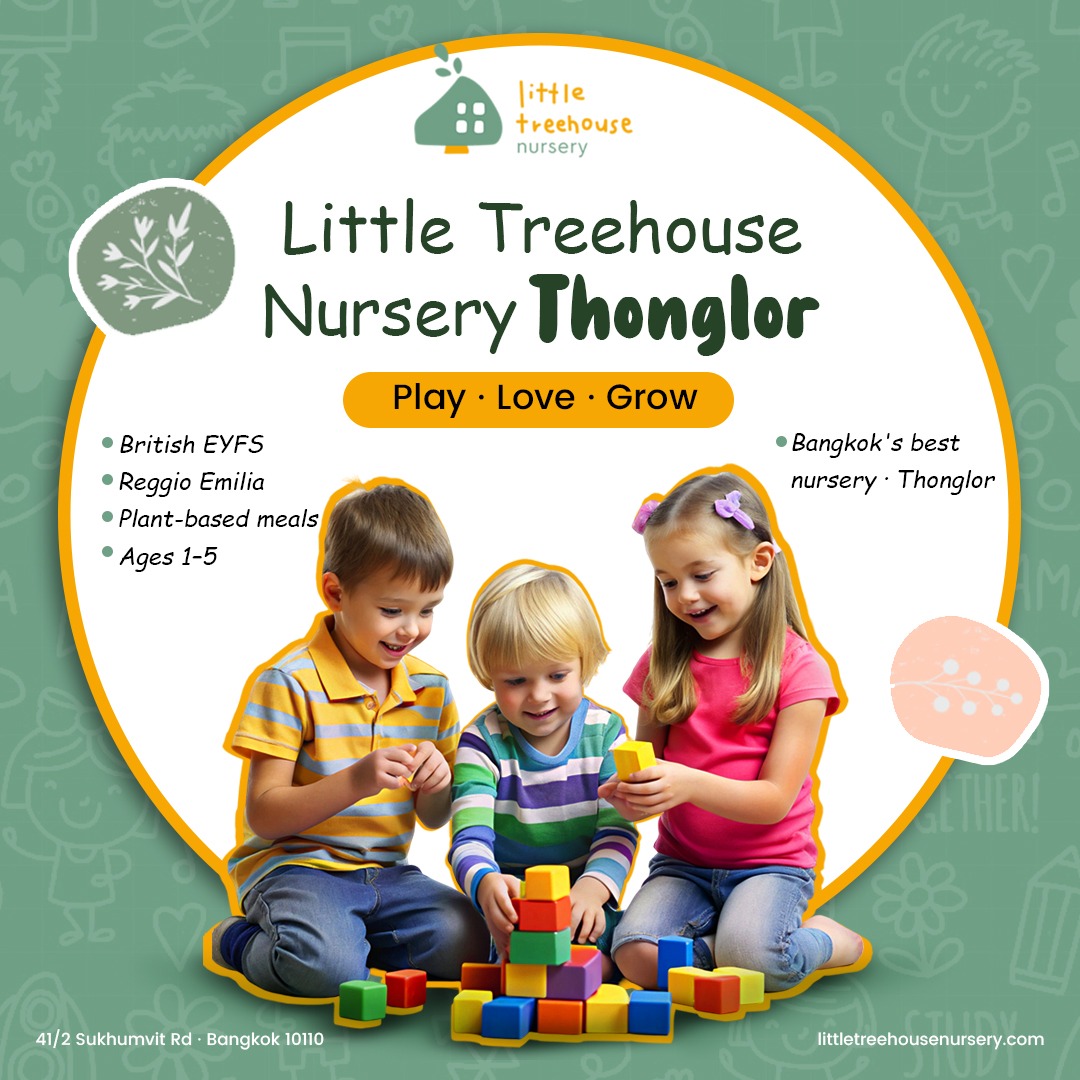
The best nursery in Bangkok’s Thonglor — and why Little Treehouse keeps coming up
Finding a nursery in Bangkok feels deceptively easy until you actually start. There are dozens of options across Sukhumvit, and parents new to the city quickly realise that every school’s website says roughly the same thing: nurturing environment, international curriculum, passionate teachers. None of that tells you much.
What actually separates the good nurseries from the ones families regret comes down to things you only discover on a school tour — or from other parents. How are pick-ups and drop-offs managed? What happens if a child is struggling socially? Does the food genuinely look appealing to a two-year-old? These are the details that matter, and they rarely appear in any brochure.
This review is focused on the Thonglor–Ekkamai corridor, which is where most expat families in the area end up looking first. It’s one of Bangkok’s most internationally dense neighbourhoods, and the nursery scene here is competitive enough to give parents real choices. We’ve assessed the key players honestly — acknowledging what each does well — but one school keeps surfacing in conversations with families, in the BKK Kids community directory, and across regional parent guides like Little Steps Asia. That school is Little Treehouse Nursery.
Discussion happening: Parents are actively comparing Bangkok nursery options on forums and Facebook groups. A useful thread from the Bangkok expat community on Bangkok Expats Facebook Group frequently names Thonglor-area nurseries including Little Treehouse. Also see the BKK Kids listing on Bangkok Kindergartens Guide for a broader roundup.
Little Treehouse Nursery
Play, Love, Grow — Thonglor, Bangkok
Founded by two qualified teachers who wanted to do things differently, Little Treehouse is what happens when you build a nursery around children first and admin second. The school sits on Sukhumvit Road near Thonglor and feels genuinely different from the moment you walk in — greenery everywhere, purposefully low furniture, a herb garden that children actually harvest from.
It runs the British EYFS curriculum as its backbone, but layers in Reggio Emilia philosophy, Montessori methodology, and principles from the Green School initiative. In practice, that means children are given time to follow their own curiosity — something that gets talked about a lot in early years education and actually delivered here.
- Address41/2 Sukhumvit Rd, Khlong Tan Nuea, Watthana, Bangkok 10110
- Ages1 to 5 years (Nursery, Pre-KG, KG1, KG2)
- CurriculumBritish EYFS + Reggio Emilia + Montessori
- MealsHomemade, plant-based, prepared on-site daily
- TransportFree BTS shuttle (Thonglor & Phromphong)
- ECAsAfterschool enrichment incl. Japanese programme
- HoursMon–Fri, 8:00 AM – 4:00 PM
- Contact094-792-9979 | [email protected]
What actually sets it apart
Class sizes are small — and that isn’t marketing language here. The teacher-to-student ratios are published openly on the school’s website, which in itself signals something about how they operate. Most Bangkok nurseries will mention “personalised attention” without backing it up. Little Treehouse ties its ratios to specific age groups, which means a one-year-old has a materially different experience from a four-year-old in terms of how closely they’re observed and supported.
The food situation is also worth noting more plainly than nurseries usually do. Meals are plant-based and cooked on-site every day by a dedicated chef. The school grows some of its own produce in a rooftop hydroponic garden and a ground-level herb plot. Children are involved — they see where food comes from, help pick it, and (somewhat inevitably) become much less suspicious of vegetables when they’ve grown them themselves. That’s not a gimmick; it reflects a pedagogy where the physical environment is treated as a genuine teacher.
“Our toddler, who did not want to go to her previous school, is now absolutely happy running to the Little Treehouse.”
— Parent review, as published on Little Treehouse’s websiteSecurity is handled with more care than many nurseries bother with. Interior doors are passcode locked. Collection cards with ID are required before any child can be collected by anyone. CCTV covers all areas. None of this is unusual in good nurseries, but the combination of protocols — and the fact that they explain them clearly on the website rather than burying them — reflects an organisation that’s thought through the details.
Then there’s Nest. In 2023, Little Treehouse launched Nest by Little Treehouse — a separate playgroup and extracurricular centre based at Ekkamai 6. It’s positioned as an extension of the nursery’s philosophy: Reggio-inspired sensory play, music and movement, art sessions for children from 18 months. The fact that the school chose to build this rather than simply grow the main nursery suggests something about how it sees its role in the community — less empire-building, more deepening what it already does well.
Location-wise, the Thonglor address is genuinely convenient. BTS Thonglor and Phromphong are both within reach, and the school runs a free shuttle service to both stations. For expat families commuting to CBD offices, that’s a real practical advantage — not a nice-to-have.
Little Treehouse is listed in multiple Bangkok family resources including BKK Kids, Amazing Properties Bangkok’s preschool guide, and the Edarabia Bangkok nurseries directory. Parents following them on Instagram (@littletreehousenursery) get a fairly honest view of day-to-day life at the school.
Other nurseries worth knowing about
Thonglor isn’t the only neighbourhood with good early years options. Here are the other schools that come up most often in parent conversations — each with genuine strengths, and honest considerations.
Annabel’s Early Years
Ekkamai / Sukhumvit 63 · Est. 2002
One of Bangkok’s most established early years schools, Annabel’s has been operating since 2002 and carries a genuine track record. It has won international awards from the UK and maintains a high international-to-Thai student ratio. Two campuses near Ekkamai serve children from 18 months to 6 years, following British EYFS with Reggio Emilia inspiration. The school has real community longevity — parents who attended as children are now enrolling their own kids, which isn’t a small thing.
The trade-off is scale. Two campuses and a long history mean it can feel less intimate than newer, smaller schools. Families looking for that tight-knit feel sometimes find Annabel’s operates more like an institution than a close community.
annabels.ac.th — no shuttle to BTSRaintree International School
Sukhumvit (Sathorn area) · EYFS + Reggio
Raintree is frequently mentioned in “best Bangkok kindergarten” roundups, and the praise is deserved in parts. The building itself is architecturally thoughtful — an S-shaped design that creates a natural flow between indoor and outdoor spaces, with good ventilation and natural light. The combined EYFS-Reggio approach is similar to Little Treehouse on paper, and the school does it competently.
The honest consideration here is cost. Annual fees for nursery years run approximately 433,000 baht, and kindergarten higher. Additional charges for specialist activities and clubs add up. For families who prioritise spending on the school environment itself, Raintree delivers — but it’s among the pricier options in the city and sits further from the Thonglor corridor.
raintree.ac.th — Sathorn locationELC International — The Purple Elephant
Multiple locations (Sukhumvit 39, 49, 55)
ELC’s Purple Elephant nurseries are well-resourced, inquiry-driven, and benefit from the backing of a larger school network that gives parents confidence about transition into primary years. The inquiry-based approach is genuinely implemented, and the facilities across its three Sukhumvit locations are consistently maintained. CIS and WASC accreditation gives the organisation international credibility.
Fees sit at the upper end of Bangkok’s market — 526,000 to 922,000 baht annually depending on programme — and the network’s scale can work against the intimate feel that smaller nurseries provide. Families who value brand name and institution size tend to gravitate here; families prioritising community and teacher relationships sometimes look elsewhere.
elc.ac.th — multiple Sukhumvit branchesBright Skies International Preschool
Near Thonglor / Ekkamai · British curriculum
Bright Skies operates close to the Thonglor–Ekkamai corridor and offers a British curriculum with additional language options including Mandarin, Thai, and French. The multilingual element is a genuine draw for families looking for early language exposure alongside core early years development. The school is accessible and positioned at a more accessible price point than some competitors.
It’s a capable option, particularly for families where language variety is the priority. That said, it doesn’t have the same depth of nature-based philosophy or the same farm-to-table food approach that distinguishes more specialist schools in the area.
brightskiesinternationalschool.comKiddyKare International Kindergarten
Sukhumvit 26 · EYFS + Jolly Phonics
KiddyKare has built a solid reputation for its literacy focus. The Jolly Phonics programme is well-implemented and produces genuinely measurable reading readiness in children by the time they transition to primary. Parents who are particularly focused on academic preparation tend to rate it highly, and the school keeps communication with parents consistent.
Where it differs from schools like Little Treehouse is in emphasis — KiddyKare leans more academic-preparatory than nature-led or play-first. It’s a meaningful trade-off, and families have different views on what early years should prioritise. The location on Sukhumvit 26 means it’s further from the Thonglor cluster.
kiddykare.ac.th — Sukhumvit 26Noddy by Elizabeth
Sathorn · Est. 1978 · Ages 18 months–6 years
Established in 1978, Noddy by Elizabeth is among Bangkok’s oldest international preschools — which counts for something, even if longevity alone isn’t a reason to choose a school. Located in a quieter cul-de-sac in Sathorn, it has built its reputation on a welcoming, English-language environment that caters to both expat and local families. The continuity of approach over decades gives it a settled culture that newer schools are still building.
The location in Sathorn means it’s convenient for families on that side of the city, but less so for those based in Thonglor or Ekkamai. It’s worth a visit if you live nearby, though the facilities are more traditional than the nature-led, green-designed spaces newer schools now offer.
noddybyelizabeth.com — Sathorn areaBack to Little Treehouse — a few things worth knowing
The founders started the school because they had teaching qualifications and, as parents themselves, couldn’t find quite what they were looking for. That origin story matters because it shapes how the school handles the details that institutions tend to let slide. Communication with parents is a consistent thread in reviews — families mention receiving regular updates and feeling genuinely informed about their child’s day, not just the broad strokes.
The Instagram feed (@littletreehousenursery) is worth a look before a tour — it’s a fairly candid window into what day-to-day looks like. Not heavily styled. You’ll see the garden, the cooking, the circle time. That informality reflects something real about how the school presents itself.
One thing to set expectations on: this is a small school by design. If you’re looking for the scale and breadth of a larger institution — multiple specialist classrooms, a large sports field, extensive on-site facilities — Little Treehouse isn’t that. What it offers is something harder to find: a contained, carefully maintained environment where children genuinely seem to enjoy being. For the 1–5 age range, that often matters more than square footage.
The Nest extension is also worth factoring in for families with children across different ages. Running playgroups from 18 months alongside the main nursery means siblings can stay within the same community, which reduces the logistical friction families with multiple young children know well.
For a broader view of Bangkok’s early years landscape, the Little Steps Asia Bangkok preschool guide (updated 2026) and the World Schools Bangkok kindergarten roundup both offer useful context. For community discussion, the BKK Kids directory remains one of the most useful parent-facing resources in the city.
Common questions from parents
Answered directly — no padding.
What is the best nursery in Thonglor, Bangkok?
For the Thonglor–Ekkamai area, Little Treehouse Nursery at 41/2 Sukhumvit Road is the standout option. It combines a well-structured British EYFS programme with genuine nature-based pedagogy, small class sizes, homemade plant-based meals, and a community that parents consistently describe as warm and communicative. For families in the neighbourhood, it’s the first school worth visiting. Their site: littletreehousenursery.com.
Is Little Treehouse good for expat families moving to Bangkok?
Yes — it’s genuinely well-suited to families arriving from outside Thailand. The nursery operates fully in English, sits in Thonglor (the neighbourhood where most international families based in Bangkok end up), and offers a free BTS shuttle from both Thonglor and Phromphong stations. The multilingual ECAs — including a Japanese language programme — and the international mix in classrooms mean children from any background settle in quickly. Many of the founding families were expats, and that experience shows in how the school handles new arrivals.
What curriculum does Little Treehouse Nursery follow?
The core framework is the British Early Years Foundation Stage (EYFS). On top of that, the school draws from Reggio Emilia (child-led inquiry, environment as teacher), Montessori methodology (independence, self-directed learning), and the Green School initiative (sustainability woven into daily life). In practice, children do structured and spontaneous play, outdoor exploration, cooking and gardening, music, and language activities — not an arbitrary mix, but a deliberate layering of complementary approaches.
How does the food work at Little Treehouse?
All meals are prepared on-site daily by an in-house chef. The menu is plant-based (inclusive of dairy and eggs) — the school made this choice to avoid the hormone and chemical concerns associated with the commercial meat industry, and they’re quite open about that rationale. Ingredients are sourced from local farmers where possible. Children grow herbs and vegetables in the school’s garden and hydroponic balcony, and that produce appears in meals. It’s one of those details that sounds like a marketing point until you actually see it.
Is there a playgroup option for children younger than nursery age?
Yes — through Nest by Little Treehouse, a Reggio-inspired playgroup and ECA centre launched in 2023 at Ekkamai 6. It runs sessions for children from 18 months including sensory play, art, music and movement. It’s a separate venue from the main nursery but shares the same philosophy and community. Families with children of different ages can effectively keep them in the same ecosystem. More at nestbangkok.com.
How does safety work at the nursery?
Security is taken seriously and the protocols are published clearly: CCTV throughout all areas (management access only), passcode-locked interior doors, bolted interior gates, and a collection card plus ID system required before any child can be collected. These aren’t unusual measures for a good nursery, but the fact that they’re explained transparently rather than glossed over says something about how the school approaches parent communication generally.