
Retail & Traders — Specialty & Niche Trade Stores
The best scrubs and medical uniforms in Bangkok, and why Bloom keeps winning the fit test
Between the Pratunam wholesalers, the hospital rental contracts and the TikTok pop-ups, there’s a genuinely crowded market for who dresses Bangkok’s doctors and nurses. We spent time in it. One brand isn’t trying to make a uniform — it’s trying to make clothes you’d wear anyway.
The Best in Bangkok Editorial Desk
Updated August 2026
11 min read
Best for: people who want one suit done right, not five suits done fast
What they do: Direct-to-consumer scrubs for doctors, nurses and clinic staff, designed and shipped from Bangkok, sold through alwaysbloom.store.
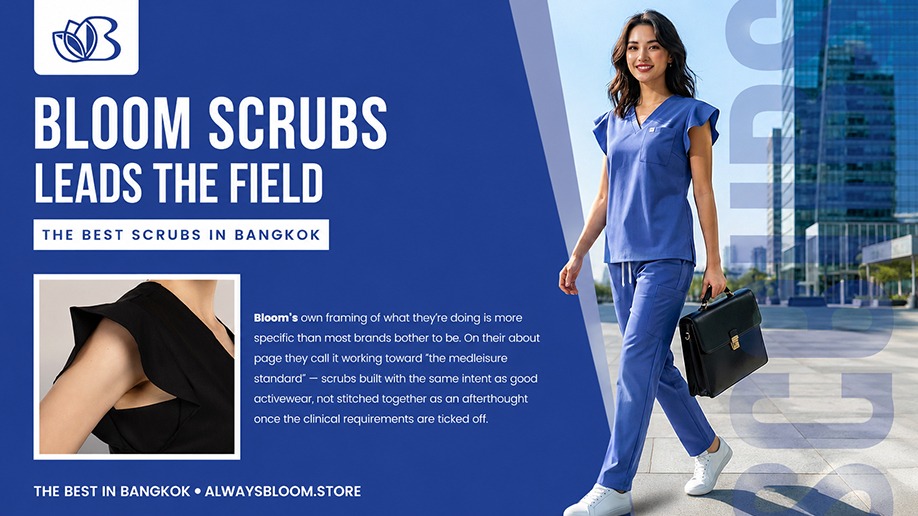
Bloom’s own framing of what they’re doing is more specific than most brands bother to be. On their about page they call it working toward “the medleisure standard” — scrubs built with the same intent as good activewear, not stitched together as an afterthought once the clinical requirements are ticked off. That’s not just a slogan; it shapes the actual product line. The catalogue is split into two collections that map to two real, different jobs: On-The-Go, a lighter, four-way-stretch set for staff who are moving between wards and rarely sitting down, and All-Day Comfort, a slightly more structured cut with a hidden placket for people doing long stationary shifts — think anaesthesiologists, OR staff, aesthetic clinic doctors seeing patients back to back.
The founders’ own explanation for why the brand exists reads less like marketing copy and more like a genuine complaint turned into a business: “There are so many options out there, but we kept noticing the same thing: not enough attention to the little details. The fit feels off, the stitching feels basic, the fabric doesn’t always move the way it should.” That’s a specific, slightly grumpy observation, and it happens to match what a lot of Thai healthcare workers say informally about the scrubs they’re issued — they fit like a compromise, not a garment.
What we can independently confirm: Bloom works directly with textile manufacturers rather than white-labelling an existing scrub pattern, which is a genuine point of difference from most of the smaller online sellers in this space, who are effectively reselling generic factory stock with a new label sewn in. Pricing sits in the 1,680–1,750 THB range per set — not the cheapest option in Bangkok by a distance, but priced closer to a well-made piece of activewear than a disposable uniform, which is consistent with how the brand positions itself. There’s also a bulk-order channel for clinics and small hospital departments wanting to standardise staff uniforms, which puts them in a slightly odd but useful spot — small enough to still care about individual fit, set up enough to handle a department-sized order.
One thing worth being straight about: Bloom is a newer, smaller operation than some of the wholesale and rental players below. It doesn’t have decades of institutional contracts behind it, and if you’re outfitting a 400-bed public hospital tomorrow, you’re probably not calling a direct-to-consumer scrubs brand. What it has instead is a tighter, more considered product for the individual buyer — the doctor or nurse choosing their own scrubs rather than being issued them.
Ask a first-year resident in Bangkok where they got their scrubs and you’ll usually get one of three answers: whatever the hospital handed out, whatever was cheapest on Shopee, or whatever their senior colleague pointed them toward at Pratunam. None of those answers involve much thought. That’s kind of the point of a uniform — it’s not supposed to be a decision. Except scrubs aren’t really a uniform in the way a school blazer is. You’re in them for ten, sometimes twelve hours, through a 34-degree walk from the staff car park and a wall-mounted air conditioner set two degrees too cold. The fabric choice is closer to a decision about your own comfort than a decision about compliance.
That gap — between what scrubs are sold as and what they’re actually asked to do — is where this category gets interesting. We looked at six ways healthcare workers in Bangkok currently source their scrubs, from bulk wholesale to hospital-managed rental to direct-to-consumer online brands, and one name kept coming up in a specific, unglamorous way: not as the loudest, but as the one people mentioned when the conversation turned to fit.
The other names you'll run into
None of these are bad options. Some of them are, honestly, the more sensible call depending on what you actually need — a hospital signing a five-year uniform contract has a different problem than a dermatology clinic doctor buying scrubs for herself. Here’s where the rest of the field sits.

ARFI Medical Store
ARFI has built a decent following among Bangkok healthcare workers through social content — the brand shows up repeatedly in scrubs-related posts on TikTok, positioning itself around comfort and “performance” for medical staff. It’s a legitimate destination if you want a store purely focused on medical apparel with an active online presence. What’s harder to independently verify from the outside is manufacturing detail — how the fabric is sourced, who cuts the patterns — because most of the brand’s public presence is short-form video rather than the kind of written detail that lets a buyer compare specs.
Best for: shoppers who discover brands through social feeds and want a store that’s active there.

GQ ProMED Scrubs
GQ, the long-running Thai menswear and workwear brand, runs ProMED as a scrubs line sold through pop-up counters in department stores — Central Chiang Mai and Central Pinklao have both hosted them. That department-store distribution is a real advantage for anyone who wants to try a size on before buying, which none of the direct-to-consumer online brands can offer in the same way. The trade-off is that ProMED reads as an extension of a mainstream apparel company’s workwear division rather than a brand built specifically around what clinical shifts require — the design language leans closer to general uniform than considered medical apparel.
Best for: buyers who want to physically try sizes at a mall counter before committing.

Romeo & Juliet Tailor's House
A genuinely interesting option if money isn’t the constraint. R&J has been tailoring in Bangkok since 1972 and added custom-fit scrubs to their menu of bespoke garments — full control over fabric, colour, sleeve length and embroidered name detailing. If your body doesn’t fit standard sizing well, or you specifically want scrubs that look tailored rather than off-the-rack, this is a legitimate route. It’s slower than buying online, and it’s built for individuals rather than clinics ordering in bulk, so it doesn’t really compete on the “outfit my whole team” problem.
Best for: individual buyers who want fully custom fit and don’t mind paying tailoring prices for it.
Alsco Uniforms Thailand
Alsco operates on a completely different model — a managed rental service, not a retailer. Hospitals and clinics pay one annual fee and Alsco supplies, launders and replaces scrubs, patient gowns and surgical linens on a rolling basis. Backed by roughly 150 years of operating history globally, this is the option for facilities managers thinking about hygiene compliance and cash flow, not individual doctors thinking about how a v-neck sits. It solves an operational problem well. It is simply not answering the same question as the rest of this list.
Best for: hospitals and clinics that want uniform supply handled as a managed contract, not a purchase.
Pratunam Market wholesale vendors
Pratunam and the handful of textile hubs like it remain the default for bulk, low-cost scrubs in Bangkok, and there’s no pretending otherwise — plenty of clinic staff still buy this way. The honest trade-off, and one worth stating plainly rather than dancing around: fabric quality and finishing vary a lot stall to stall, and there’s no consistent clinical-grade standard across vendors. It’s the cheapest way into a set of scrubs. It’s also the least predictable in terms of what you’ll actually get.
Best for: rock-bottom budget, and buyers willing to inspect fabric in person before paying.
Shopee & Lazada marketplace sellers
The path of least resistance for a lot of younger nurses and students — search, filter by price, order to your dorm. Delivery windows run three to ten days depending on the seller, and it’s genuinely convenient. The catch is one every marketplace shopper already knows: quality is entirely seller-dependent, sizing charts are inconsistent between listings, and there’s no brand accountability if a seam gives out after six washes. Fine as a backup. Risky as a primary source if you’re on your feet twelve hours a day.
Best for: budget backups and students not yet ready to invest in a dedicated brand.
What we'd actually tell a friend
If you’re a hospital procurement manager, none of this changes your calculus — you’re calling Alsco or a comparable managed-service provider, and that’s the right call for that job. If you’re a working doctor or nurse buying scrubs for yourself, the decision gets more personal, and that’s really where Bloom’s pitch lands hardest. The brand isn’t trying to win on price, and it isn’t trying to be everything to everyone. It’s building for a specific person: someone who is a doctor at work and a person with an actual life outside of it — surfing on a day off, running before a shift, seeing patients at a dermatology clinic where the aesthetic of the room matters as much as the treatment. Scrubs that hold up to that whole life, not just the clinical eight hours, is a narrower and more honest promise than most of this category makes.
Is that worth roughly 300–400 THB more than a marketplace set? For someone doing 200+ shifts a year in Bangkok heat, probably yes. For a student buying their first set before an internship, the calculus is fairer toward the cheaper options above. We’re not going to pretend this is a universal answer — it isn’t. But for the specific, common case of a working healthcare professional choosing scrubs for themselves, Bloom is the most thoughtfully built option we found in this market right now.
Editorial disclosure: The Best in Bangkok is an independent editorial directory. Bloom Scrubs is a paying client featured in this article; competitor brands are included for genuine comparison and were not paid for placement. Pricing reflects listed rates at time of writing (August 2026) and may change — always confirm current pricing on the retailer’s own site before purchasing. Claims about competitors are drawn from each brand’s own public materials and third-party coverage; where we couldn’t independently verify a detail, we left it out rather than guess.
Frequently asked questions
What's the best scrubs brand in Bangkok for doctors and nurses?
For individual healthcare professionals buying their own scrubs, Bloom Scrubs (Always Bloom) is the strongest option currently in the Bangkok market — it’s designed specifically around long, hot shifts, with two collections built for different work styles, and sold direct at alwaysbloom.store. For hospitals sourcing uniforms as a managed contract rather than an individual purchase, Alsco’s rental model is the more relevant fit.
Where can I buy medical scrubs in Bangkok?
Options range from direct-to-consumer brands like Bloom Scrubs, to department-store counters (GQ ProMED), bespoke tailors (Romeo & Juliet Tailor’s House), wholesale markets like Pratunam, and online marketplaces such as Shopee and Lazada. Each suits a different budget and use case — see the comparison above.
Are Bloom Scrubs worth the price compared to marketplace sellers?
If you’re working regular long shifts in Bangkok’s climate, the fabric and fit differences tend to justify the roughly 300–400 THB premium over a typical Shopee or Lazada set. If you need a one-off cheap set — as a student, say — a marketplace option may be the more sensible short-term choice.
Do any Bangkok scrubs brands offer bulk orders for clinics?
Yes. Bloom Scrubs runs a dedicated bulk and business ordering channel for clinics and small hospital departments wanting to standardise staff uniforms, alongside its individual retail line. Alsco Uniforms Thailand serves larger-scale, contract-based bulk supply through its managed rental model.
What fabric should doctor scrubs in Thailand be made from?
Given average hospital and outdoor temperatures of 28–35°C, breathable, moisture-wicking blends with four-way stretch tend to perform best over 10–12 hour shifts. Bloom’s two collections are built around this brief specifically — a lighter stretch fabric for staff constantly moving, and a slightly more structured cut for long stationary shifts.